Presentation
of XXXth Ludovic-Trarieux International Human Rights Prize 2025
Speech by Yves Oschinsky,
President of
the Brussels Bar Human Rights Institute.
Conscience, courage, struggle.
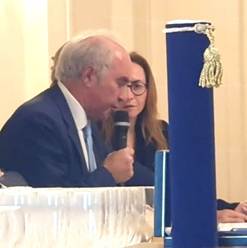
Conscience,
courage, struggle. These are the qualities of a lawyer that you magnificently
embody, dear Dmitry Talantov, my very dear colleague.
Indeed, it took
your conscience, your courage, and your struggle to express your opinion in
several Facebook posts in 2022.
You posted a photo
of a man standing in Red Square with a sign reading, "Ukraine - peace.
Russia - reason, horror, shame, repentance. Putin - hell."
You wrote, as a
caption: "And how can it be any different after the photos and videos from
Kharkiv, Mariupol, Irpen, and Butcha? This is no longer fascism; these are
extreme Nazi practices!" If, after this, the majority of my compatriots
support the murderer Pou and his gang, I personally refuse to recognize them as
human beings. People have the capacity for compassion. And these people are
nothing but stupid and diabolical scum.
There is nothing
here but the expression of an opinion. It is nothing more than freedom of
expression. We ourselves, citizens of democracies supporting Ukraine, share
your indignation. At home, we can say it and write it.
But you, in this
Russian Federation trampling on fundamental rights, were arrested on June 28,
2022, at your home, in Yevsk, in the Republic of Udmurtia, of which you are the
President.
You were already
bothering, because there are countries where the Powers-keepers who do not
support the government are annoying, especially if, like you, you were the
lawyer of the journalist Ivan Safranov, whose previous lawyers had been
harassed and suspended from their status as lawyers because they were
campaigning for human rights.
Your client,
deprived of your defense following your arrest, was sentenced on September 5,
2022 to 22 years in prison for high treason, in a trial held behind closed
doors and without evidence against him.
You are placed in
solitary confinement, which you will describe during your trial:
I have been in
prison now for two and a half years. I have been in an isolation cell for two
years, in a pitiful medieval cell, where the only amenities of civilization are
toilets and a sink with water that flows non-stop.
There is nothing
here but the expression of an opinion. It is nothing more than freedom of
expression.
We ourselves,
citizens of democracies supporting Ukraine, share your indignation. At home, we
can say it and write it.
But you, in this
Russian Federation trampling on fundamental rights, were arrested on June 28,
2022, at your home, in Yevsk, in the Republic of Udmurtia, of which you are the
President.
You were already
bothering, because there are countries where the Powers-keepers who do not
support the government are annoying, especially if, like you, you were the
lawyer of the journalist Ivan Safranov, whose previous lawyers had been
harassed and suspended from their status as lawyers because they were
campaigning for human rights.
Your client,
deprived of your defense following your arrest, was sentenced on September 5,
2022 to 22 years in prison for high treason, in a trial held behind closed
doors and without evidence against him.
You are placed in
solitary confinement, which you will describe during your trial:
I have been in
prison now for two and a half years. I have been in an isolation cell for two
years, in a pitiful medieval cell, where the only amenities of civilization are
toilets and a sink with water that flows non-stop.
You have health
problems but the medical assistance you are seeking is denied.
You are the first
convicted under Article 207.3, introduced in 2022 into the Criminal Law,
punishing the public dissemination of knowingly false information about the use
of the armed forces of the Russian Federation.
At the hearing,
however, you stated:
How could I
knowingly make false and discredited statements that do not match the
information of the Ministry of Defense, if the positions of the Ministry of
Defense have not yet been published?
Article 207.3 of
the Russian Penal Code provides for very heavy penalties, punishing a
non-violent offense with a penalty comparable to that of offenses such as
murder. This article is criticized in the light of the Russian Constitution and
the international obligations of the Russian Federation, as well as the
fundamental principles of law.
The prosecutor
asked for a 12-year prison sentence, and in your last word, you said:
As for the
12-year prison sentence, it would be simpler to speak of life imprisonment or
death penalty . It is according to the taste of each.
I'm not trying to
frighten you, I sometimes think that today it's not so scary to die, what is
really scary is to live. But you have to live, I'm sure, you have to live.
And you speak about
what you are accused of:
What can I say
about this? Ultimately, it is also a matter of moral choice. I am told that I
wrote these few words (my messages on social networks) out of hatred. What
great feeling of hatred must this be to push a man not to kill, but to go to
prison out of compassion for the dying?
Of course, I could not ignore that all this could end for me as it ended.
And on November 28,
2024, you are sentenced to 7 years of general prison colony, as well as a
4-year ban on running websites or Internet channels.
And then, through
what must have been a sham of procedure, the Court of Appeal, by a judgment of
October 31, 2025, reduced your sentence by 2 months.
We think of you and
it is said that you face your conditions of detention with strength and
courage. And here again, you force our admiration.
The United Nations
Special Rapporteur on the situation of human rights in the Russian Federation
had called for your acquittal and she cites you, in her recent report of 15
September 2025, as an example of the intensification of the persecution of
lawyers in Russia.
You are a victim of
the denial of the rule of law and your situation must be strongly denounced by
the international community in order to obtain your release.
This is the whole
meaning of your Ludovic Trarieux Award.
Yves Oschinsky
Speech
by President Anton LANA,
Chairman UFTDU and IDHAE
Freedom is like air: you only realise
its value when it starts to disappear.
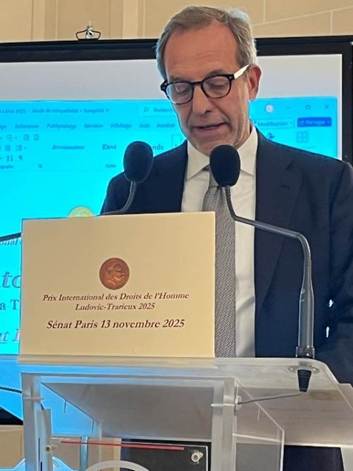 These are the words of Piero
Calamandrei, one of the most important Italian jurists of the last century,
professor at the University of Florence, and mentor of my father, Mario Lana.
These are the words of Piero
Calamandrei, one of the most important Italian jurists of the last century,
professor at the University of Florence, and mentor of my father, Mario Lana.
It is an honour and, at the
same time, a profound responsibility for me to be here today, on behalf of the
Unione Forense per la Tutela dei
Diritti Umani (Italian Lawyers Union for the Protection of Human Rights) and
the Institut des Droits de l Homme
des Avocats Europ ens (Institute for Human Rights of
European Lawyers), to pay tribute to lawyer Dmitry Talantov, winner of the 2025
Ludovic Trarieux Prize.
This award is a tribute that
the international legal community reserves for those who, at all times and in
all places, have chosen to defend human dignity even at the cost of their own
freedom.
Today, we honour a lawyer who
decided not to remain silent in the face of injustice.
Talantov has practised law as
an instrument of freedom in a context where freedom has become a personal risk.
Talantov was, for a long time,
president of the Bar Association of the Republic of Udmurtia (in Russia) and a
prominent figure in the regional legal profession. He has always been very
critical of the Russian government s persecution of lawyers and has also
challenged his colleagues who have remained neutral in the face of this
intimidating behaviour.
Talantov came to public
attention when he joined the defence team of Ivan Safronov, a former journalist
who worked for Russian newspapers and covered military and space issues.
Safronov was sentenced in September 2022 to 22 years for high treason, in a trial
that many international observers believe was motivated by his journalistic
work and publications concerning the Russian military.
Talantov, meanwhile, took a
stand against the invasion of Ukraine, expressing his views in several posts on
social media, and was arrested on 28 June 2022 on the following charges:
spreading false information about the actions of the Russian armed forces
abroad (Article 207.3 of the Russian Criminal Code) and incitement to hatred
(Article 282). In particular, Talantov, in contesting the invasion of Ukraine,
denounced the atrocities committed by the Russians in places such as Bucha,
Irpin and Mariupol.
The trial had characteristics
that various international observers described as lacking transparency:
prolonged pre-trial detention, the declared exclusion of the public in some
parts, and the defendant s profession as a lawyer as justification for imprisonment.
On 28 November 2024, a Russian
court sentenced Talantov to 7 years in a general penal colony and banned him
from practising law for 4 years.
For this reason, his case
concerns not only Russia, but all of us.
It concerns the very meaning
of the role of a lawyer: to be, anywhere, the first bulwark between power and
the individual, between arbitrariness and the law.
At a time when lawyers are
called upon not only to interpret the law but also to safeguard its spirit,
Talantov reminds us that the law is never neutral in the face of human rights
violations.
He embodied the universal
conscience that binds every lawyer in the world to the same oath: to defend
dignity, unconditionally.
Today, while Dmitry Talantov
cannot be here with us, his name resonates as a symbol of civil and moral
resistance that transcends borders.
His voice, silenced in Russian
courtrooms, echoes in this chamber, within the walls that preserve the memory
of European freedoms.
We cannot ignore what is
happening today in Russia, where numerous lawyers, journalists and human rights
defenders are subjected to pressure, intimidation and unfair trials.
Like Talantov, they are paying
the highest price for believing in the power of words, the law and the truth.
But this is precisely why the
international legal community must be more united and vigilant than ever.
Every lawyer imprisoned for
practising their profession is a blow to the universal rule of law.
Every time a human rights
defender is silenced, silence envelops us all.
The Ludovic Trarieux Prize is not just a medal, nor is it an act of
remembrance: it is an act of testimony.
Each year, with this award,
the legal community reaffirms a simple but vital principle: that justice is not
only an institution, but a moral vocation; that a lawyer is not a legal
technician, but a guardian of freedom.
In Talantov, we find the
strength of those who, even knowing they risk everything, have not given up
defending others.
His example asks us not to
look away, not to become accustomed to fear, never to accept that the law
should become an accomplice of power.
Finally, allow me to express
my gratitude and affection to Dmitry Talantov s wife, who is here today and
whose presence bears witness to the continuity of a hope that no prison can
extinguish.
Through her, may Dmitry
receive our respect, our solidarity and the certainty that he is not alone.
His battle is ours; his
strength belongs to us.
Today, in the name of Ludovic
Trarieux, we remember that freedom is not defended once and for all, but every
day, in every courtroom, in every word spoken for justice.
And that the legal profession,
when it remains faithful to its principles, is a supreme form of civil courage.
May this award be, for Dmitry
Talantov, not only a recognition, but a message to the world: justice can be
imprisoned, but it cannot be defeated.
Anton Giulio Lana
Speech by
Mr Bertrand FAVREAU
on behalf of
the Jury
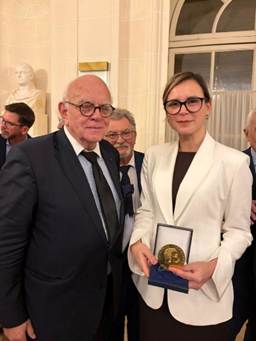 Isn't celebrating a birthday always about
bringing back memories? For some, they have the force of signs or symbols. For
others, they are never just coincidences or coincidences. For the poet, they
are only appointments. After all, everyone will choose their party.
Isn't celebrating a birthday always about
bringing back memories? For some, they have the force of signs or symbols. For
others, they are never just coincidences or coincidences. For the poet, they
are only appointments. After all, everyone will choose their party.
Yet, as we hand over this 30th
prize, could we refrain from redoing a journey that is still initiatory, yet
retrospective and as moving as it is sad, the one that will have led us, at the
end of 40 years, into a landscape that has always been revisited with destinies
devastated by the suffering of others. We had obviously left South Africa and
we went to China twice. Coming from Zimbabwe we had to, twice again, go to
Burma.
And even when we had to go as far
as the times, to places considered lush but not very benevolent for real
lawyers, whether in Peru, Mexico, Brazil, Colombia or Cuba, we were confronted
with the same distressing observation. We have also shared the servitudes and
injustices that befall lawyers in Kazakhstan and Belarus, as well as in Syria,
Libya, Egypt and Afghanistan, but also in Saudi Arabia and the United Arab
Emirates. And it is this same forced journey at the whim of so many rights
despised, ignored, martyred that brings us back to Russia today, 15 years after
Mrs. Karina Moskalenko, who came especially today among us and whom I like to
greet on your behalf with as much gravity as respect at this moment.
But, are we in Russia to tell the
truth? The Russia we know and love? Tonight, we must go further, further,
further to the east, 1000 km east of Moscow, in Udmurtia, to the borders of the
Urals, land of the borders by nature and par excellence. For us, seen from our
elemental West but only in appearance, the Urals is the limes, it is the end of
Europe, already another continent. In truth, most of us knew nothing about it
until tonight, except the very present memory of Boris Pasternak's writings.
Not the Boris Pasternak of Jivago, of course, not the Pasternak of the 1958
Nobel Prize, because all this was 30 years later But of the young Boris
Pasternak, the one of 1917, the one who knew how to bequeath to us at the whim
of tetrameters in dactylic rhymes, his first emotion, as strange as brutal,
during his discovery of the lands of the Urals, called the Urals for the
first time . Unfortunately, illiterate of the Slavic languages that we are, we
can only read it in French, to hope to find the fleeting shadow of the great
bronze massifs , the ghosts of spruces, fuliginous water , the veil
embroidered with gold and stones, snow and frost Pasternak too, would
experience persecution, prison, then exile. But all this is, one might say, a
matter of poets.
The capital of Udmurtia is
Izhevsk. The world does not know it either, except for its gun and shotgun
factories. But she is also famous for one of her children whose name has become
so famous, that it is today a common name that everyone pronounces with fear or
dread. Because, the most famous citizen of Ijevsk because he died there in
2013, is called Mikhail Kalashnikov. Yet Izhevsk, for us, is and will remain
more the city of Dmitry and Olga Talantov. Because that's where they both
practiced their fine profession as lawyers.
In a very short time, Dmitry
Talantov had tried, it is true, the profession of judge, but he had then
understood that one can engage in the practice of law only in a free exercise.
The law needs freedom. His reputation as a lawyer and his spirit of independence
had soon crossed the borders of Udmurtia. He had become the president of the
bar. This is probably why in 2021, in a crucial phase of the trial, he was
appointed as a lawyer by the journalist of the independent daily Kommersant,
Ivan Ivanovitch Safronov, accused since 2020 of state treason . He appeared
to be criticized for allegedly passing on allegedly secret albeit publicly
accessible information to Czech intelligence agencies. Dmitry Talantov thus
became the defender of the last hope and certainly, it took a great courage to
accept the cause that would change his life.
Last hope certainly. For, to tell
the truth, since his arrest, Safronov had seen all the bad luck unless it was
the FSB's special attention fall on him and his previous lawyers. His first
advice had never had the right to access the documents in the file. Moreover,
both the substance of the charges and the charges had to remain secret and the
first condition for being admitted as a lawyer by the Federal Security Service
was to give a solemn undertaking not of confidentiality but in reality of
secret procedure and those who had agreed to defend him were hunted down,
prosecuted and persecuted.
Just one month after Safronov's
arrest in August 2020, the Ministry of Justice sent the St. Petersburg Bar
Association a request there will be others for the disbarment of one of its
previous lawyers, Ivan Petrovich Pavlov which should not be confused in any
way, even by reflex, with another Ivan Pavlov, who was his doctor. This Pavlov
there led a well-known defense collective in Russia, "Komanda 29" -
or Team 29 - a free partnership of lawyers, journalists and activists who also
defended the foundations of Alexei Navalny, prosecuted for
"extremism". Ivan Pavlov had refused to sign a so-called modestly
non-disclosure declaration. In a word, he refused to be silenced and used as an
alibi or hostage in a covert prosecution.
From then on, Ivan Pavlov could
only be arrested at every moment and in fact he was arrested in April 2021, in
Moscow where he had been forced to go to try to defend his client. Faced with
the silence that was opposed to him, he had considered in the interest of his
client, to have to at least make public the litany of arbitrary accusations
articulated against the prisoner of state. First released, then prosecuted,
relentlessly hunted down and under threat of radiation, Ivan Pavlov had no
other way out in the fall of 2021 than to flee Russia to take refuge in
Georgia. Safronov s other lawyer, Yevgeny Smirnov, also had to leave Russia for
Georgia a few weeks later after a disciplinary investigation was opened
against him. It was, in fact, a professional investigation of a special nature
for a lawyer: it was conducted by the Federal Security Service with the aim of
feeding the disciplinary file of the bar. Pavlov and Smirnov had in fact lasted
only a few months. They had lost their careers and their homeland there.
Certainly, from his first steps
on the file, Dmitry Talantov was in no way unaware of what awaited him. As soon
as the threats began, he knew that he would, like his predecessors, enter an
uninterrupted maze of pitfalls, suffering and advances, especially since the
fate of his two colleagues already announced the worst.
Against the lawyers, the hunt
follows more subtle meanderings. It is permanent, nagging, obsessive as if too
direct, too brutal measures could be too gentle. Monitored, tracked, the
lawyer, the journalist and the activist are exposed every day more to be placed
on the list of foreign agents . Admittedly, the measure introduced in its
current regime in 2012 had initially only affected human rights organizations
collectively. Most often, it was a question of stifling them, preventing them
from acting and denouncing them, but also obviously of eradicating them slowly
but inevitably. But from 2020, it is a weapon of individual destruction that
has been pointed directly at the heads of lawyers. To be registered, to be on
the list of foreign agents , is to be subjected on a daily basis to the full
range of measures of prevention and discrimination of the law. It is to be
marked, designated, denigrated, to suffer a withering, as it was claimed, in
France, to inflict them on slaves in the eighteenth century.
Foreign agent is supreme
disqualification, red iron, stigmatization and a professional death warrant.
The lawyer on the list must now, in all his professional acts, follow his name
and title with an additional line: foreign agent . Everyone therefore
understands that this lawyer does not have long to maintain the trust of his
clients and the consideration of his judges. The greatest jurist can't resist
it. Especially since the measure of opprobrium, the lawyer also ends up most
often being condemned and finally disbarred by his peers, even if sometimes we
have seen some aspirations for independence which are only a facade resistance.
During exile, persecution continues. Ivan Pavlov was declared a foreign agent
and disbarred long after he left for Georgia.
Safronov's new lawyer accepted to
be eventually threatened. Because he was a lawyer. Not only did he stay, but he
continued to defend. However, he did not have time to know the fate of his
predecessors. He experienced worse and faster: prison. The destiny of men is
inseparable from history in which events that escape them are projected
inexorably. And one day for Talantov, the moral duty of every human being came
to prevail over the legal obligations of the lawyer. Unless, in reality,
they're always one.
We know that all too well. On the
morning of February 24, 2022, the Russian armed forces invaded Ukraine. This is
the beginning of the special military operation . Special the word far
from sweetening makes you shudder especially since special, it turns out to
be. One day, Dmitry Talantov finds himself faced with the brutal revelation
prompted by photos, reports and testimonies demonstrating at will the
procession of abuses of the soldiers of the Russian army in Bucha, Mariupol,
Kharkiv or Irpen, he understands that this army resulting from the glorious
patriotic army of 1812 and the Great Patriotic Army of 1944, is indubitably
engaged in crimes, at least war and can be even worse, under the guise of a
special operation and that it perpetrates certain acts than those committed
in certain circumstances of which the Second World War has transmitted to us so
many examples as unbearable as inexcusable.
And, as the slow investigation of
the Sofronov case continues and the noose has already tightened against Dmitry
Talantov, here he is, confronted with a terrible case of conscience. For him,
it is no longer a question of censorship or prohibition, of freedom to say or
not to say, it is a revolt that deafens the depths of himself and that
transforms and transports his being.
But he was faced with a
prohibition of the law while everything in him urged him to speak, or even to
shout. Eternal dilemma of the lawyer as of the human being. He wanted to talk,
but there was a law. The terrible new law of paragraph two of article 270.3 of
the Criminal Code, the law adopted just a few months earlier, a week after the
start of the total war in Ukraine, which specifically forbade talking about it.
In advance, the law criminalized
any publication of false information about the use of Russian armed forces
abroad and executions by Russian government bodies, committed on grounds of
enmity or hatred. However, any information not validated by the Kremlin is
deemed false and disseminated for reasons of enmity or hatred .
But Talantov was willing to
expose himself to the law. But it would probably be too simple, too elementary,
to reduce one's choice to a demand for freedom of expression. Talantov's
assumed torment was of an otherwise more essential quintessence. At the heart
of this ontological conflict for a jurist, yet a law-abiding servant by
definition, between his will for freedom and the laws promulgated. Talantov was
finally alone as in this hermeneutic dialog that everyone knows between the
priest and the famous K. in the no less famous chapter at the cathedral , of
the trial of Kafka.
Vor dem Gezetzt. Under the law,
we must choose and therefore not wait. Choose before a door closes. Because
Kafka tells us that this is a personal door that will only open once.
Beyond the indescribable courage,
there was certainly strength and panache on the part of this president in his
messages against the horrors of the war thus launched to his contemporaries
from the city of Kalashnikov. Previously, it is true, an administrative
procedure had been opened against Talantov for one of these articles in which
he dared to write that the partisans of the war had no place in a judicial
profession but in truth is of such banality that it had almost gone unnoticed.
But this time, his colleagues were watching and denounced him so that he could
be prosecuted. For not keeping quiet despite the prohibition of the law when a
mass violation of human life was at stake.
And on June 28, 2022, as the
trial of his client Safronov will open in a few weeks, Dmitry Talantov was
arrested.
June 28. Terrible echo. From date
to date. 50 years later. Suddenly, what we call in French a flashback comes up,
and we, a reminiscence. Here is a curious coincidence or sad anniversary that
returns this 28th of June of sinister memory. A memory that projects us 50
years back, day to day. It was June 28, 1972. That day, another lawyer was
confronted with a law that defended, against a law that wanted to silence,
against the law that also punishes violating it. Oh, it was only a procedural
law, certainly, and he was not in prison for it. But that lawyer, too, had
little time to choose. And after a long debate, he had chosen to break the law,
in this case the law that could allow to kill the one who, he had not killed.
On that day, He had chosen to break the law in the light of the necessity that
was imposed on him, in the name of another law of higher essence, to try to
respect a higher human principle: the requirements of truth and the right of
every being to life.
This lawyer was, of course,
Robert Badinter, on the day he argued before the Assize Court of the Aube
department in the trial of Roger Bontemps. The prosecution was about to ask the
jury for the death penalty. The law, the code of criminal procedure, prohibited
the lawyer, on pain of being prosecuted, from referring to an annulled expert
report that established that his client was not a murderer. Faced with the
reversal of an expert shedding his previous conclusions and facing an announced
death sentence, Robert Badinter did not waver. He chose to expose himself. For
a lawyer must also know how to violate the internal norm when a law of higher
essence comes to impose itself on him, that of humanity. His act led to a
suspension of the trial, the suppression of the truth but also against himself
a judgment of the Court sending him back to face disciplinary proceedings.
We know what comes next. The
final report, the report that could exempt an accused person from death, is not
part of the proceedings. And the next day, - everyone knows the story - June 29
- Roger Bontemps whose expert had said he had not killed was sentenced to
death. On that day, contrary to the verse of Guillaume Apollinaire, only the
Aube department was defeated by twilight. For from then on, another story began
that would lead from the Execution to the Repeal. Robert Badinter would win the
fight begun. A man's fate would defeat the forces of darkness.
For Dimtry Talentov, all other
things unequal, it was obviously the life and death of the men who were in
question and who determined his choice, but the stake for him was obviously not
only disciplinary. On 28 June, he was immediately transferred from Ijevsk to
Moscow before being remanded in custody by the Cheryomushki District Court.
Temporary? at least one could think so since at least until Safronov's
trial, before his transfer, he had undergone searches in four premises linked
to him, including his home and the office of the President of the Udmurtia Bar
Association, and he had been able to see the documents, notes and other
documents relating to Safronov's defense, carefully scrutinized before being
confiscated and piled into the luggage of the police officers before
disappearing forever.
For the FSB, the five messages of
April were a godsend without rivals. Now he was definitely at their mercy, both
the lawyer and the client. Safronov was now defenseless two months before his
trial and Talantov caught in their net.
Two months later, on September 5,
2022, in Moscow, Ivan Safronov, deprived of a lawyer, was sentenced to 22 years
in prison for "high treason", the heaviest sentence that Russian
courts have come to hand down and in general only in cases of murder. Until the
investigation is complete, the Federal Security Service will have kept the
charges completely secret: it will have only had to remove the lawyers from the
case.
Locked up, Talantov had to endure
the daily life of the prison regime within the penal colony. The slow and
inexorable prison torture he has been subjected to for more than three years.
He described it himself. A few months after his arrest, he was placed in an
isolation cell, a pitiful medieval cell , where the only amenities of
civilization were toilets and a washbasin with water that ran constantly. In
addition, there are holes in the wall above the door, a loudspeaker is mounted
there to broadcast the instructions for using a gas mask that are read in a
loop by an actor with a voice as enthusiastic as sound. Every evening at
bedtime, the national anthem is played in powerful loudspeakers before the
continuous night stream of state radio sets in. He is not allowed to sleep
because of the torture of patriotic decibels. Sleeping remains a hope that is
always in vain because, although it does have a space for this purpose,
generously described as a berth , it is in reality only a vulgar board on
which it is possible to lie down for no more than two to three hours. The
description will be stopped here. A French citizen, however, will force himself
to be restrained at the moment to evoke medieval cells worthy of Ivan's era,
says the terrible, since he knows only too well that his own country shares
with Russia, in number as in diagnosis, the overwhelming and redundant
condemnations of the European Court of Human Rights because of the state of its
prisons.
So, trying to get away (is it
possible in this case?), one would easily be tempted to find refuge with
detachment in Dostoevsky. It is true that in France one cannot help but mention
his name when it comes to confinement. But no, unfortunately, Fedor Dostoyevsky,
if he has certainly taught us that the justice of humans can only lead to
injustices , - this could provide here as elsewhere a relevant subject of
reflection and close the debate - Dostoyevsky has never written as one tries
to repeat tirelessly but not without ending up tiring, in an agreed but
unusable maxim on the occasion of any special criminal law colloquium in France
and the United Kingdom - that one can only judge the degree of civilization
of a nation by visiting its prisons , formulates also declined according to
other variants. He didn't write it, even about the Tobolsk prison or the Omsk
prison. Neither in the Memories of the House of the Dead, nor in Crime and
Punishment, or even in the Idiot. After all, anyone can continue the search.
Thus Dostoevsky, as in France
Saint-Exup ry, Clemenceau or Albert Camus seems condemned to endorse the
paternity of a cohort of apophthecies and other orphan maxims that their lips
have never spoken and that their pen has never written. But perhaps he could
have said it so clearly that the judgment is exemplary or that the sentence
is magnificent , as Victor Hugo would have said which one cannot help but
quote when one evokes Robert Badinter. The sentence, even without an author,
certainly expresses an irrebuttable truth.
Dmitry Talentov, meanwhile, chose
to refer stoically to another, more contemporary Russian author, the poet
Joseph Brodsky. He, too, had been imprisoned in the Arkhangelsk Oblast before
being released and sentenced to exile in the United States where he died. He
too had been awarded the Nobel Prize for Literature in 1987, coincidentally? -
30 years after Boris Pasternak, before finding eternal rest today in the San
Michele cemetery of Venice, somewhere between Diaghilev and Stravinsky.
Talantov likes to quote him, repeating his striking definition of the prison in
the form of a joke, halfway between Cioran and scar Wilde: the prison is a
lack of space compensated by an excess of time . [ ] Every minute kills, and
every minute over there is an hour.
After more than 30 months in
detention, two years after Safronov's final conviction on 18 November 2024,
Dmitry Talantov was in turn sent back to court. Before the court of Udmurtia,
in Ichesk, his court, the one before which he had practiced his profession,
with which he had exercised the functions of president. Neither to the court,
nor to the prosecutor who was demanding 12 years in prison for the five
messages, he did not want to express regret. Because he doesn't regret
anything. Or rather, if he asked for forgiveness, it was only to his wife Olga.
Before taking the time, from his glass cage, which wanted to gag him more and
more, to exhale as a last cry barely muffled: Olga, I love you!
Ten days later, the judges before
whom he had so often appeared sentenced him to seven years' imprisonment in a
general-regime penal colony, depriving him for four years of the right to
engage in the full range of activities related to electronic, information and
telecommunications networks.
His appeal against this
conviction was raised just a few days ago in a court on 28 October. No doubt to
justify the principle of its existence and by virtue of what occult criteria
are unknown, she meticulously calculated that the lost honor of the Russian
armed forces could after all be sufficiently cleansed with 20 days less
imprisonment for Dmitry Talantov. She hit him with six years and 10 months of
penal colony. 82 months instead of 84 months
Faced with the butchery of
Butcha, the killing of Mariupol, the excesses of Kharkiv or the genius of
Irpen, Dmitry Talantova thought that no law could be legitimate to chain the
courage of a man even a lawyer to remain silent and agree to hide the truth. It
is sometimes said, following the precept of a famous Geneva philosopher, that:
Consciousness is the voice of the soul . Thus the voice of Dmitry Talantov
will have been the consciousness of the eternal soul of the Russian people as
we love them so much and that nothing will ever destroy.
Also, do not doubt it, Madame,
beyond the trial of too long a time, the darkness of Joseph Brodsky's shrunken
cell will cease and the rediscovered Urals of the young Pasternak of twenty
years will give birth again to the light, the fuliginous dawn that he breathed
will reappear and the ghosts of the spruces will become alive and free again.
Other men then, will start again to stretch out crowns to the fir trees, to
summon them to proclaim themselves kings. And Dmitry Talantov, you can be sure,
will be remembered by the people of his country and by others.
That is why we are happy and
proud to put back, now, in your hands, exactly 40 years after Nelson
Mandela-Symbole? Or rather Rendez-vous, as Paul luard would have said, this
XXXth prize which bears the name of Ludovic-Trarieux.
Bertrand Favreau
Presentation of
XXXth Ludovic-Trarieux
International Human Rights Prize 2025
2025
Speech by
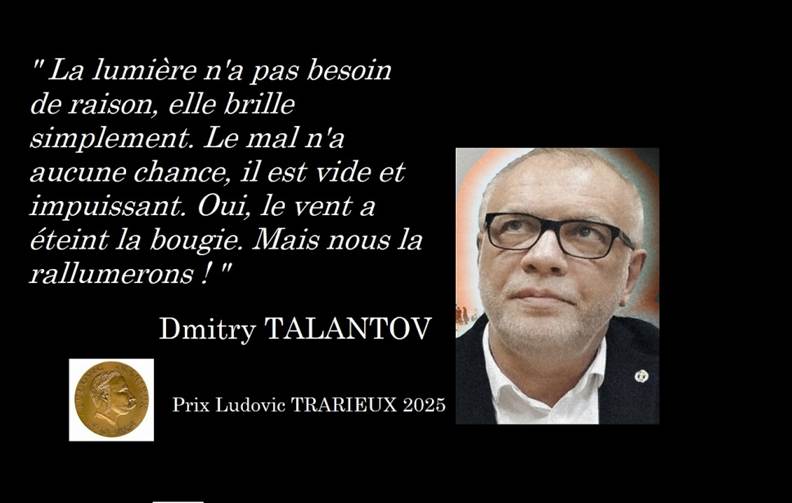
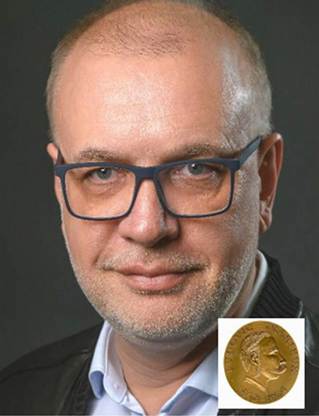
Dmitry
Talantov,
Prize-winner
of the Ludovic-Trarieux International Human Rights Prize2025
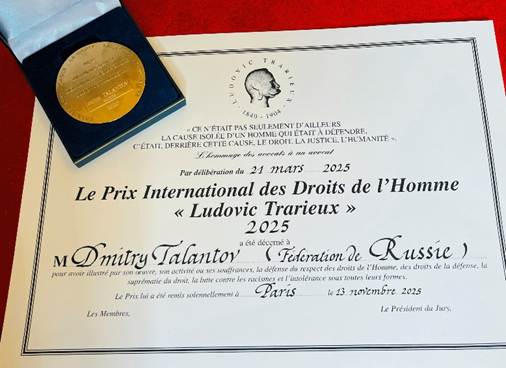
On November 13, 2025, the Ludovic Trarieux
International Human Rights Prize was awarded to Olga Talantova, the lawyer and
wife of Dmitry Talantov.
The speech written by Dmitry Talantov, translated into
French, was read at the award ceremony on November 13, 2025.

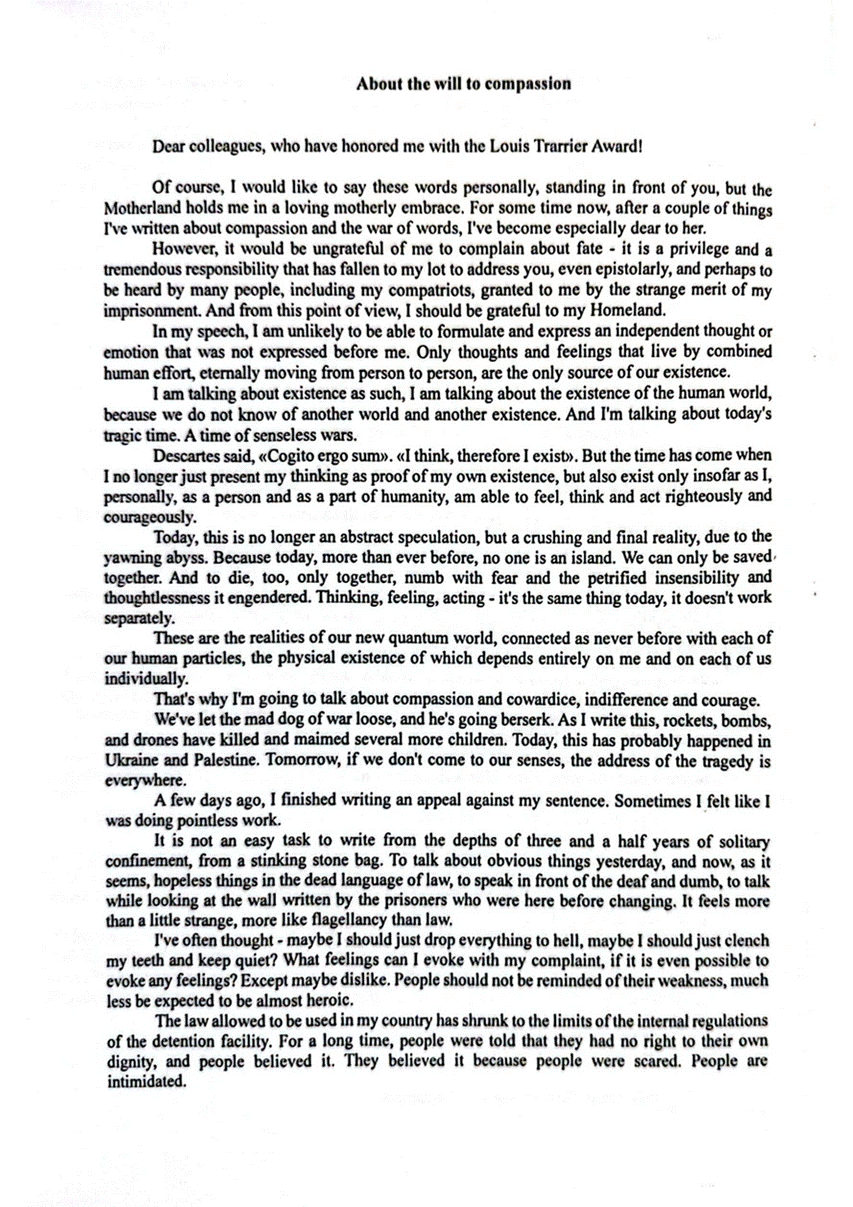
Dmitriy
Talantov